
Browse all guides
ARRANGE & STYLE
Looks
Make a layer look different when a condition is true.
In this guide
Give a piece another appearance for certain times#
Suppose you want a weekend label to appear only on Saturday and Sunday. Or you want a battery value to change color below a level you choose. A Look stores that alternative appearance and the rule for when to use it.
It works on the same piece of your widget; you do not need another widget design. Normal is its usual appearance. A Look takes over when its rule matches. The rule is called a condition in these instructions.
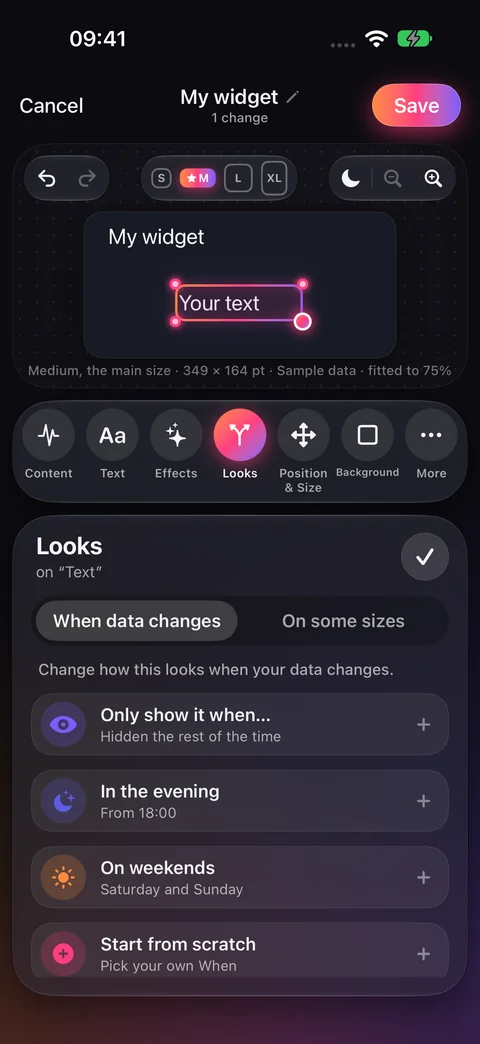
Open a saved widget in Library, tap Design Visually, select the piece, and tap Looks in the toolbar. Use When data changes for values, times, weekdays, or web data. Use On some sizes for an appearance tied to a widget size.
Add a Look#
Open Looks
Select a layer and tap Looks → When data changes.
Choose a starting point
Use one of the offered starts, or Start from scratch. The starts depend on the selected layer.
Set When
Tap the words in the condition to choose what to check, how to compare it, and the number or time to compare against.
Set What changes
Choose what should change, such as color or visibility. Open the offered tool to edit that change.
Set the condition#
The When sentence is editable. Tap its data name to open the picker, its comparison to choose how it is checked, and its number or time to change what it is compared against. The controls depend on the field.
You can add another condition with And also. All conditions in the Look must match.
Choose what changes#
What changes lists the changes for this Look. Edit through its offered tools while the Look is open. Use its visibility switch to hide or show the layer in that Look.
Layout settings are not all available in data Looks. The app tells you when a setting stays the same in every Look. Use a size Look for supported changes tied to a widget size.
Put Looks in order#
The app tries data Looks from top to bottom and uses the first one that matches. If none match, it uses Normal. To change that order, select the layer and open Looks → When data changes. Use the up and down arrows beside the Look cards. Those arrows appear when there is more than one Look. Move a Look up if it should take priority.
A preview of an edited Look helps you design it. It does not mean its condition currently matches your own data.
See every Look at once#
With nothing selected, tap Looks in the toolbar. The panel lists every Look in the widget, sorted by its When, with the layers each one changes. Tap a Look to open it.
Each condition has a switch. Turn it on to pretend the condition is true, and the canvas shows your widget as it would look then: a heart rate over 100, a rainy afternoon, a weekend. All on and All off pretend every condition is, or isn’t, true. Back to live data stops pretending.
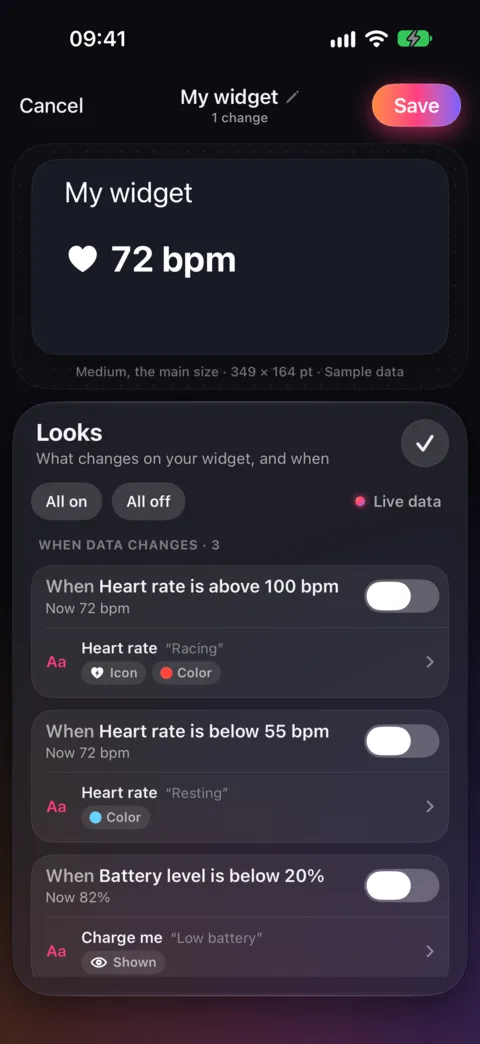
Each condition, what it’s now, and what it changes.
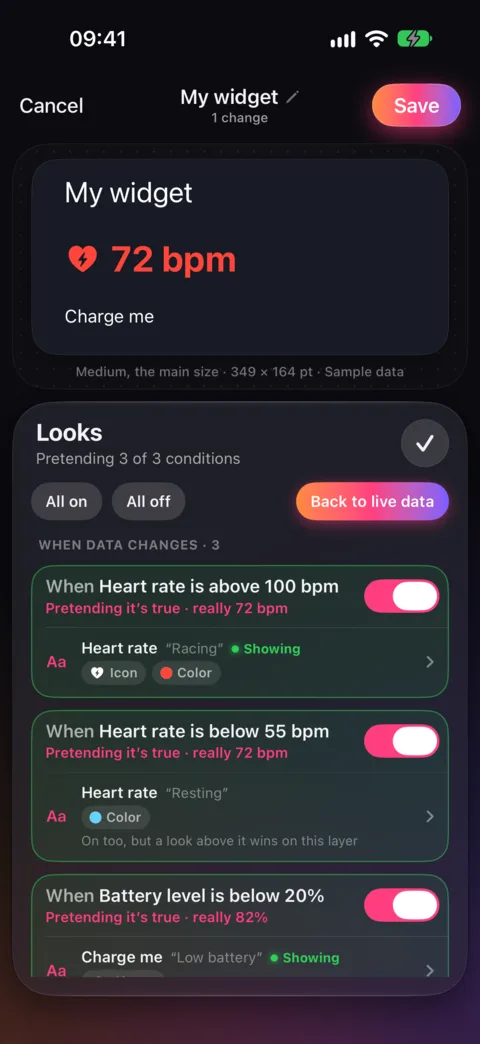
All on: the heart turns red and Charge me shows up.
Pretending is only a preview. Nothing is saved, and your Home Screen widget still follows the real data.
Looks for pages and taps#
A layer can also look different while a page shows, or after a tap. When the widget has those, the top of the layer’s Looks panel has pills: Data, Sizes, Pages and Taps, each with how many Looks it has.
- Pages
- How the layer looks while each page of a container shows: a lit tab, a turned knob. More about pages.
- Taps
- What a Change things tap does to this layer.
In the overview, with nothing selected, While a page shows lists every container whose pages change things, and lets you preview each page.
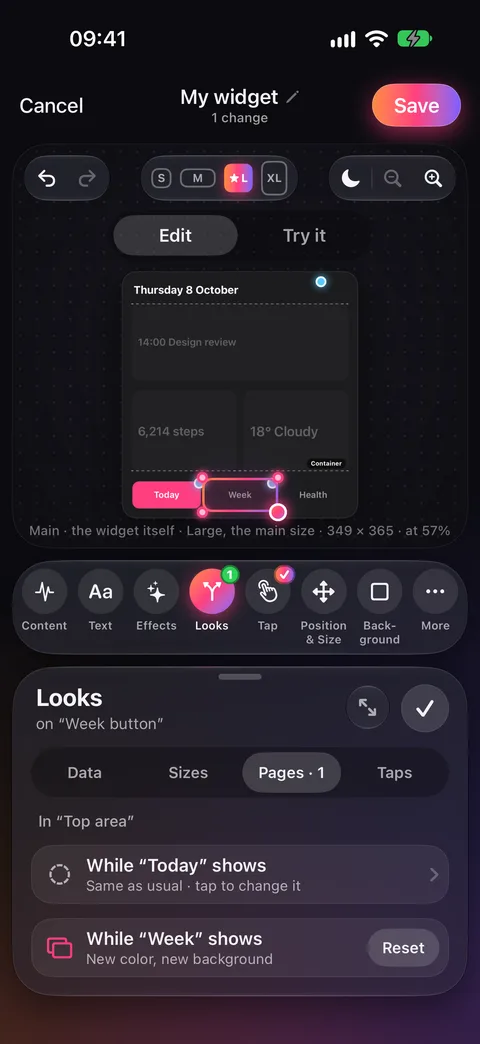
The Pages pill: how the Week tab looks on each page.
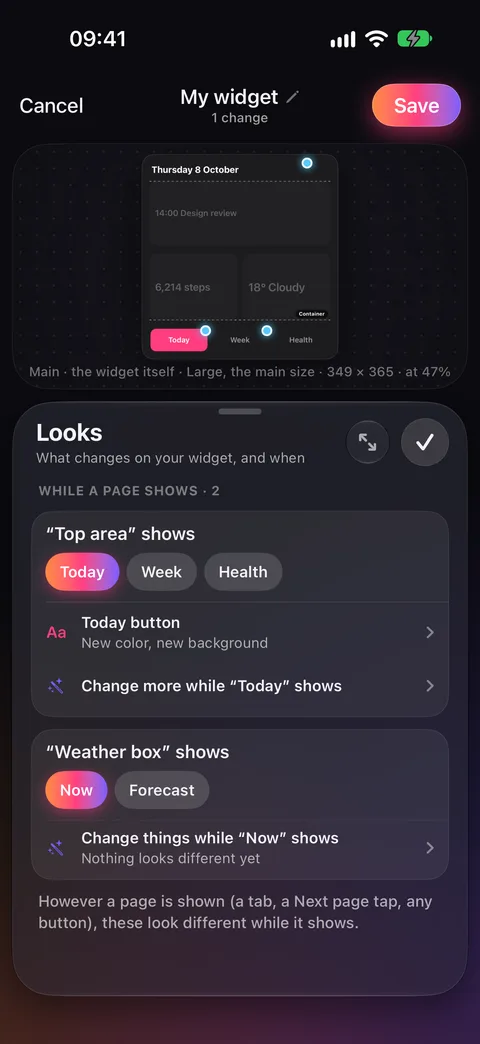
Every container, its pages to preview, and what changes on each.
Rename or delete a Look#
Select the layer, open Looks → When data changes, then tap the Look card. Scroll inside the panel to the name field beside the pencil and Delete look button. Tap the name to edit it. Deleting a Look removes that rule; it does not delete the layer. Save the widget to keep the changes.
Checked against the app · October 24, 2026.
Screenshots use example data or the app’s test image.